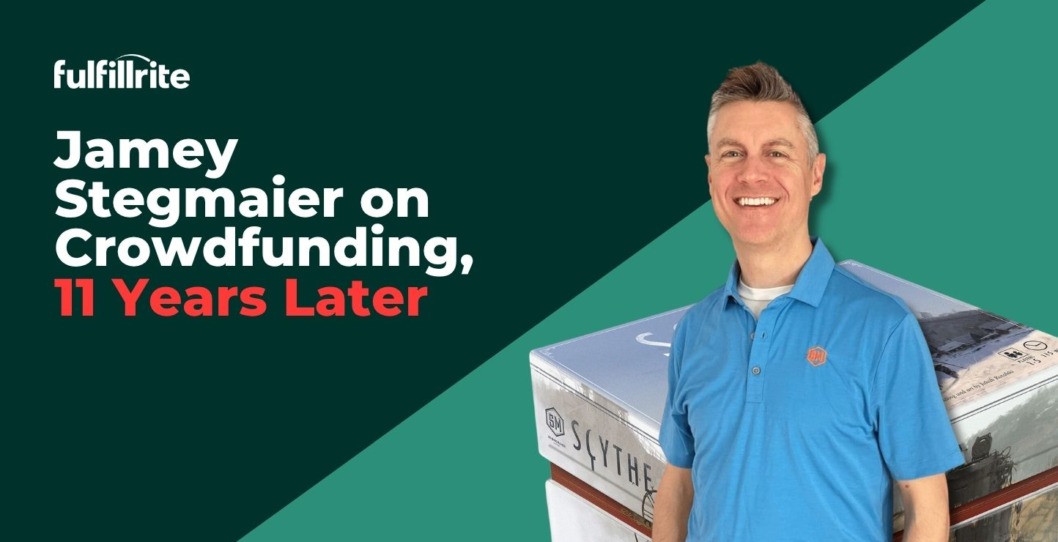
On October 13, 2015, we published an interview with Jamey Stegmaier about building an audience for Kickstarter. That same day, Jamey launched Scythe on Kickstarter. The campaign would go on to raise $1,810,294 from 17,739 backers.
A lot has changed since then. Crowdfunding itself is much bigger and more professional. Kickstarter reported $220 million pledged to successful tabletop games in 2024 alone, and creators now have major alternatives in Gamefound and BackerKit. Stonemaier Games changed as well. Scythe ended up being its last Kickstarter campaign, and the company began launching games much closer to when they were ready to ship such as Wingspan.
But crowdfunding did not become irrelevant to Jamey in the process. In a 2025 interview with The Motley Fool, Jamey said Stonemaier’s decision was “not a knock on crowdfunding or Kickstarter.” In fact, he backs plenty of campaigns himself. He also continues writing and talking about what crowdfunding creators do well on his blog.
So when this year’s Stonemaier charity auction brought us back together, we got nostalgic and went back to the old interview. We pulled out five pieces of advice from 2015 and asked Jamey by email: do you still agree with this?
The answer is mostly yes. But the details are interesting because he has even more context for his reasoning these days.
1. You still need a platform, but you have to give people a reason to come back.
In 2015, Jamey’s first recommendation was to have a platform.
His examples were a blog, podcast, YouTube channel, Facebook page, or newsletter. He recommended creating content regularly so people had a reason to find you, stay in touch, and interact with you.
His 2026 answer rhymes with his original recommendation:
In 2026, I think it’s still very important to have a hub—a place where people can find and follow your company/product. I believe that if that hub is only a repository of information about our products and doesn’t provide any further value to people, they don’t have much of a reason to return.
He added another reason for creating content that was not emphasized as much in our prior interview:
Also, even when I’m talking about my products (in writing, in a podcast, or in videos), I’m honing invaluable communication skills (i.e., every time I teach a game, I get better at teaching that game).
His current practice is consistent with that answer. In the 2025 Motley Fool interview, Jamey said he had published two Stonemaier blog posts every week for roughly 12 years. Those posts are not primarily about promoting Stonemaier Games. Instead, he uses them to share information, process ideas, and learn from the discussion that follows.
2. Understanding a community doesn’t require constant presence.
Jamey’s second recommendation from our 2015 interview was to “hang out where [communities related to what you’re making] already exist.” In short, get to know the kind of people who might be interested in what you’re doing.
His 2026 answer is a little more permissive about what that participation might look like.
I still believe there’s huge value in, at the very least, understanding how people talk about the types of products you want to make. Even if I’m just reading forum discussions and not participating, I’m learning about perceptions, expectations, and standards.
Participation matters, but he specifies here that even paying attention can be useful in its own right. In gaming, he specifically named BoardGameGeek, some YouTube channels, and, to a lesser extent, Reddit, Facebook, and Instagram.
This accords well with something he said in this Game On Tabletop interview from 2022. When asked which lesson from crowdfunding still affected Stonemaier, Jamey said the “element of community” was what stuck with him the most. He talked about engaging with people and listening to them, and using what he learns to improve products and the company.
3. Generosity still matters, even if it’s not strictly necessary.
This is perhaps the clearest instance of Jamey’s thinking evolving from 2015 to 2026. In 2015, Jamey called generosity with your time, talent, information, and money one of the most important ways to build a community. This was in contrast to being purely self-serving and self-promotional.
In 2026, he still values generosity, but no longer describes it as necessary for success:
Is this necessary to run a successful campaign or company? I don’t think so. Does it demonstrate that you care about the people who will be using your product more than you care about how you will benefit? Absolutely, and I think that can have a huge impact.
He gave me a concrete example of what he means by email, saying he’s more drawn to creators that share their thoughts and excitement about games from other publishers rather than talking only about their own products.
This also lines up with how he describes his own content in the 2025 Motley Fool interview. He said he makes videos about games from other designers and publishers partly because he thinks he has something useful to add, and partly because he learns from thinking out loud and from the discussion afterward.
4. Kickstarter campaigns still function like early-bird rewards.
In 2015, Jamey’s position was that “a crowdfunding campaign is an early-bird reward.” The campaign already gives backers a limited period to get the product under campaign terms. His objection to an additional early-bird tier was that someone who discovers a live campaign on day two should not get a worse deal than someone who happened to find it a few hours earlier.
His 2026 answer starts simply: “100% still agree.” He then clarified that if you want to incentivize early backing, you can instead offer a reward to all backers if a certain threshold is met in the first 48 hours. And if you miss that, add it as a stretch goal later on.
Scythe gives us a good contemporaneous example of his operating philosophy from 2015. Its Kickstarter FAQ says Stonemaier treated the entire campaign as “one long early-bird reward.” Once the campaign ended, prices went up. This lines up with his enduring view that joy, excitement, and enthusiasm are better levers for getting people to back than fear of missing out.
5. Finish what you can before you ask backers to take a risk.
In 2015, Jamey recommended launching with a product that was roughly 95% finished, then using the crowd to help complete a deliberately chosen final 5%. He also warned to know exactly what that 5% was before launch so that what is changeable and what’s not changeable is clear to both you and the audience before you take it to the public venue of Kickstarter.
In 2026, his position is still largely in line with that.
I think this is more important than ever before. A crowdfunder is effectively asking backers to give them money for a product that backers won’t benefit from for 1-2 years. The least you can do is to finish everything in your control before you ask backers for their trust and hard-earned money.
And he also clarified here what constitutes “everything in your control” for a board game:
This doesn’t mean that the art and graphic design—both significant expenses—need to be complete, but you can absolutely finish the design, development, and playtesting in advance.
A crowdfunding project need not be completely manufactured before launch. Creators should finish what they reasonably can before asking backers to fund the rest.
His public comments elsewhere are consistent with this principle. In the 2022 Game On Tabletop interview, Jamey described his “magic secret” for delivering close to schedule. On his later crowdfunding projects, he tried to have the game design done, graphic design and art done or nearly done, manufacturer samples ready, and manufacturer quotes in hand before launch.
It should be noted here that, per this 2025 Zatu interview, Stonemaier Games now releases products only after they are “fully designed, developed, produced, and ready to ship.” They send to fulfillment centers and retailers and then announce so customers can receive them within weeks.
But keep in mind, this is the Stonemaier post-crowdfunding model. It’s how they operate now. He has been explicit that not every creator or publisher can finance products that way. So his 2026 crowdfunding advice is narrower: finish what is in your control before asking backers for their money.
From Fulfillrite’s side of the process, we would add that logistics planning belongs in that pre-launch work too. Manufacturing quotes do not tell you what freight, customs, postage, and fulfillment will ultimately cost. So if you want to learn more about that, we have separate guides on Kickstarter shipping costs and Kickstarter reward fulfillment for that part of the planning process.
What Changed in 11 Years?
Less than you might expect.
Jamey still recommends having a platform serve as a hub of communication. But he now puts more emphasis on giving people a reason to return and on using content creation as a way to improve your communication.
He recommends spending time in communities you want to serve. But he points out that even reading discussions without direct participation can teach you about expectations and standards.
Generosity still matters even if it’s not a direct ticket to financial success. It’s a good way to show you care about the people who use your products.
His thoughts on early-bird pricing are largely the same. The campaign itself is the early-bird period.
And as for product readiness, the basic advice remains stable: finish what you can. If anything, that’s a slightly higher bar than in 2015, though not a different principle.
The mentality may be largely the same, but Stonemaier itself has changed plenty. After Scythe, the company stopped crowdfunding its own games. Jamey has said Stonemaier is now fortunate enough to finance production before taking payment.
What’s interesting is just how portable his Kickstarter lessons have been. In 2015, he published A Crowdfunder’s Strategy Guide: Build a Better Business by Building Community. Eleven years later, Stonemaier no longer crowdfunds its games. But Jamey’s still building a community.