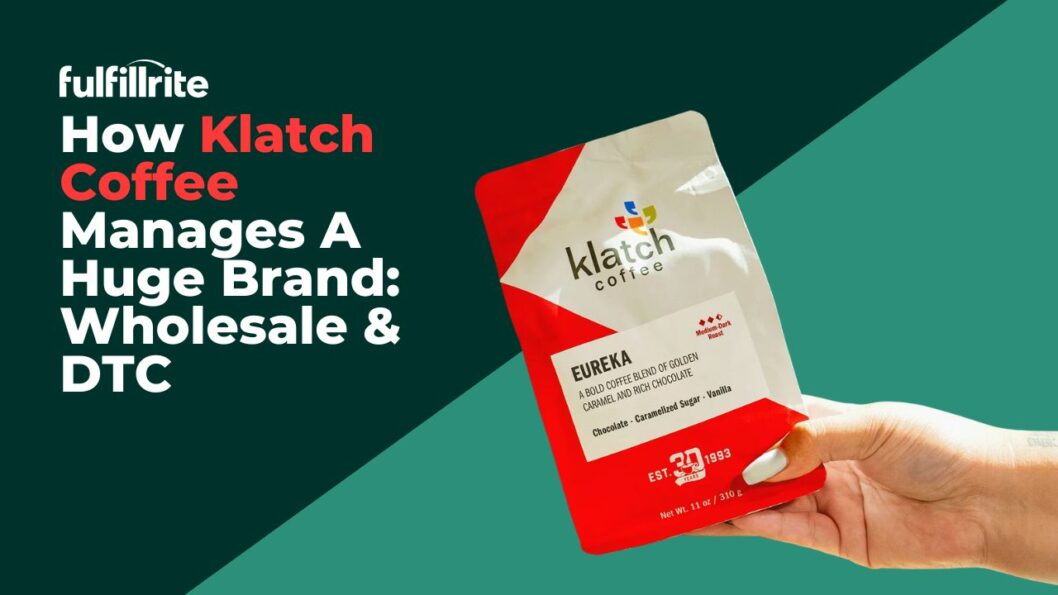
Imagine managing fresh-roasted coffee in grocery aisles and supplying independent restaurants and cafes, while also doing private labeling and custom blending, providing business coaching to aspiring cafe owners, AND expanding into 20 new retail locations.
That’s a lot to handle. Especially when you’re doing it as coffee prices hit record highs and new tariffs get slapped on imports.
That’s the reality for Klatch Coffee, the Rancho Cucamonga-based family roaster that’s been building direct relationships with coffee producers for 30 years.
Founded in 1993 by Mike Perry and his wife Cindy, Klatch Coffee has grown from weekly coffee dates to a multi-channel operation. And it’s a big one that includes standalone cafes, wholesale partnerships, direct-to-consumer eCommerce, and now a major expansion into Sprouts Farmers Market stores.
Today, CEO Heather Perry (a 2-time US Barista Champion) and Director of Retail Holly Goldsworthy run the family business. Justin Christopher, Manager of Ecommerce and Marketing, helps orchestrate the myriad factors that going into keeping quality high across every channel.
As Justin says, “we’re all on board with building an interest and appreciation for high-quality specialty coffee. Everyone’s success is our success, because our primary goal is to spread joy one cup of great coffee at a time!”
This is the story of how a family-owned coffee roaster handles the major operation that has grown through the cumulative changes that happen over 30+ years of business. Much of this is thanks to the relationships Klatch Coffee has built up over the years, and that’s a theme we’ll explore in detail in this entrepreneur feature.
Wholesale, DTC, Private Label, and Everything In Between
Let’s start with the obvious question: how does Klatch Coffee manage so many different channels?
“We’re fortunate to have some great wholesale partnerships,” Justin says. “Those partnerships take place in a few different forms. We have fresh-roasted coffee in the grocery aisle at retail partners, we supply organizations like independent restaurants, cafes, and churches, and we offer private or white labeling and even custom blending.”
Some partnerships look completely different. “Finally, we also have partners like UC Riverside, who operate their own businesses, but serve Klatch-inspired beverages and display ‘We proudly brew Klatch Coffee’ signage,” Justin explains.
“We also use our knowledge and expertise to help business owners with menu development, equipment selection, and training at our State-of-the-Art training lab,” Justin notes. “Someone interested in opening their own cafe can reach out to Klatch Coffee for business coaching to help them be successful.”
The result is “a lot of different channels and customers, in addition to direct to consumer sales!”
Now it’s not too hard to imagine how you can slowly add channels to a functional business over the decades, one at a time, like repainting the walls of an old home. But with multiple channels can come complexity (or if you prefer, chaos). So how do they do all this without the channels competing with one another?
“Internally, we work to make sure our departments like sourcing, production, and marketing are supporting all the channels we ultimately sell in,” Justin explains. In other words, they don’t let information silos build up between wholesale, retail, and DTC.
When Coffee Prices Hit Historic Highs
Expanding across channels is challenging when coffee prices hit record highs.
“The state of the world coffee market is fairly challenging currently,” Justin explains. “Prices paid by importers and roasters reached new record highs in early 2025, retracted slightly over the Summer, and remain at historical highs as we enter October.”
Then it got worse. “This was all before new tariffs were added on imports to the United States, too,” Justin notes. “Add new tariffs on some key countries (such as Brazil—the world’s largest coffee producer), and you have a recipe for price increases on the grocery shelf or in your favorite cafe.”
So this begs the question: how does Klatch maintain quality without pricing themselves out?
Three decades of relationship building.
“Our Roastmaster and Founder, Mike Perry, plays a critical role in keeping quality high,” Justin says. “Over Klatch Coffee’s 30 year history, he’s developed personal relationships with some of the world’s best producers—many that go back decades.”
Those relationships are a tremendous strategic advantage for the company. “Since we know those producers so well, we have a big head start in choosing coffees that meet our quality standards,” Justin explains.
Keeping Coffee Quality High
Price is one factor, but it’s far from the only factor. Quality is arguably more important, and Klatch sets a high bar. “We only select coffees that score 90 points or above to ensure quality,” says Justin.
It’s here again that Klatch’s existing relationships—and commitment to building new relationships—makes a big difference. “To keep quality high, we’re constantly evaluating coffees, producers, and even entirely new countries of origin to see if they make sense to add to our selection.”
The Direct Trade model makes this sustainable during price spikes. “Additionally, we purchase coffee with a Direct Trade model—we work directly with farmers and producers, cutting out the traditional middle man and allowing us to pay at least 25% above market minimums to ensure our partners are also making livable wages!” Justin explains.
This is supply chain strategy: “Keeping the whole supply chain sustainable and supported is a big part of what we do,” Justin notes.
One important subset of quality, of course, is consistency. Many popular products are blends from multiple origins, which can make keeping quality consistent more than a little tricky.
“Some of our most popular offerings are blends that contain coffee from multiple origins,” Justin says. “Because coffee harvests vary from year to year, the ‘recipe’ for those blends must constantly be monitored and adjusted, so that the flavor is consistent and familiar to the coffee drinker—even when the harvest varies due to climate, temperature, rainfall, soil conditions, etc.”
Delivering consistency when raw materials vary requires serious quality control. “Our QC team and roasting team works hard in this area to deliver these types of results,” Justin explains.
Holiday Coffees & Small Lots
Coffee might seem year-round, but keeping customers engaged requires seasonal thinking.
“As we head into the holidays as of the time of this writing, I’m reminded that we’re launching our 2025 holiday coffees and gift boxes on October 16!” Justin says. “Coffee makes a wonderful gift, and it’s perfect for sharing with friends and family, creating memorable conversations over a cup.”
Special occasion coffees keep things fresh. “We love celebrating a specific holiday or occasion with a special coffee that exists only for a short time—Mother’s Day, Christmas, and so on,” Justin notes. “That helps keep it fresh and interesting for the daily coffee drinker or visitors who come to our cafes multiple times every week.”
It’s here that direct trade creates another advantage: access to coffees larger roasters overlook.
“Because of our direct trade relationships with producers, we’re able to buy in smaller lots, and that means getting access to special coffees that would be overlooked by larger roasters,” Justin says. “Sometimes we only have a few weeks supply, which helps keep things fresh for enthusiasts—there’s always something new to try!”
Club Subscriptions & Recurring Revenue
Subscriptions form a major part of eCommerce strategy. “Subscriptions are also a big part of our eCommerce business,” Justin notes.
Klatch offers two models: standard repeat and Club subscriptions.
“We do offer the ability to subscribe to and receive the same coffee over and over (and many customers do that), but where we really shine is our Club subscriptions,” Justin explains. “Subscribers receive a new selection each month, expertly curated by our team.”
The Club subscriptions serve educational purposes. “This option is great for expanding your knowledge and appreciation of specialty coffee,” Justin says. “Club shipments can introduce subscribers to a new processing method they would not have otherwise experimented with, which keeps things interesting.”
Klatch provides guidance: “Our monthly Club selections also include a postcard with a brewing guide so customers can quickly get the best results without having to experiment,” Justin notes.
The curation is family-driven: Mike Perry curates Single Origin Club, Heather Perry curates Espresso Club, Holly Goldsworthy curates Blends Club.
This also gives Klatch Coffee an opportunity to present its suppliers in the best light too. “We like to ensure that we tell the full story when presenting a new coffee online,” Justin explains. “What’s the back story of the producer? Where was it grown? What’s the climate like? How were the beans processed?”
Breaking Into Sprouts Farmers Market
The biggest recent news is Klatch’s partnership expansion with Sprouts.
“In conjunction with National Coffee Day, we just announced our expansion into 20 new locations inside Sprouts Farmers Market stores across Southern California,” Justin says. “We have 9 new cafes coming in the next 2 quarters, then 11 more in 2026, including our first in San Diego County.”
This expansion will more than double Klatch’s current cafe footprint.
“There’s a close alignment of values between Klatch Coffee and Sprouts Farmers Market—we support one another in our goals,” Justin explains.
The geographic strategy makes sense. “Our partners are all over California, while our cafe business is focused on SoCal—so those partners help us reach customers that aren’t near enough to visit our own cafes,” Justin notes.
The partnership mindset: “They’re partners, not competitors!” Justin emphasizes. “We’re still winning when new customers discover Klatch via social media, online search, or consumer review sites, regardless of where they ultimately end up enjoying Klatch Coffee.”
The omnichannel approach is deliberate. “We win in the marketplace when consumers discover Klatch Coffee, no matter what channel they prefer to shop in,” Justin says. “We want to be part of the conversation regardless of where they make their buying decision.”
What Metrics Does Klatch Coffee Track?
With their big omnichannel approach, you might wonder where Klatch Coffee looks to understand how their business is doing.
“Website sessions are a good leading indicator that will predict our sales in the near future,” Justin explains. “Traffic is higher when we have a compelling selection of new coffees, offers that reward consumer loyalty, and newsworthy events to share with our base.”
Traffic without conversion doesn’t pay bills. “Ecommerce conversion rate is a measure of how effective we are at communicating our messages to those visitors,” Justin says.
Subscriber metrics get special attention. “We’ve also invested heavily in our subscription business over the last year, so we carefully watch the subscriber metrics to make sure the coffees we are selecting are resonating, the delivery experience is timely, and we’re delivering a great value to subscribers,” Justin explains.
Agility and Expertise vs. Scale
How does a family-owned roaster compete with Starbucks?
“As a smaller, more agile competitor I think we have some key advantages to play up compared with national chains,” Justin says.
The first advantage was touched on earlier but is worth reiterating. There’s expertise at the top. CEO Heather Perry is a 2x US barista champion, and “is heavily engaged in menu design and development, tweaking, testing, perfecting until something new is ready for the public,” Justin explains.
“Controlling the entire supply chain from sourcing, roasting, packaging, and distribution is [another advantage],” Justin notes. This makes sense especially when you consider the deep relationships that Klatch Coffee has built over the years.
Scale creates constraints smaller roasters don’t face. “Massive national chains simply can’t manage individual relationships with small, niche coffee producers around the world—but roasters like Klatch Coffee are agile enough to still have personal relationships with those producers, experiment with the roast until it’s perfect, and distribute the fresh-roasted coffee in small batches,” Justin explains.
Klatch’s size is a feature, not limitation.
Changing With the Times
When asked what surprises him, Justin pointed out that “the pace of change is always shocking,” he says. “Whether it’s technical changes like needing to update to a new subscription platform or making sure your website works on the latest mobile devices, things happen fast.”
The future comes faster than expected. “Soon it will be shopping with AI agents or within large language models—perhaps in the future, ChatGPT will discuss your coffee preferences with you and recommend the perfect beans from Klatch Coffee!” Justin notes.
His attitude is one of forward-looking optimization, with him saying “I love the challenge of adapting to whatever the market develops.”
What’s Next for Klatch Coffee
From weekly coffee dates in 1993 to 30+ cafes in 2025. From Rancho Cucamonga to wholesale partnerships across California. From standalone cafes to 20 new Sprouts locations.
Klatch Coffee proves family-owned specialty roasters can compete with national chains through agility, expertise, and direct relationships rather than scale.
Managing wholesale, DTC, private labeling, custom blending, business coaching, and retail locations across sourcing, production, and marketing is—unquestionably—a lot.
But 30 years of relationship building is what makes it work, as does a serious commitment to the highest of quality.
Explore Klatch Coffee at klatchcoffee.com or find locations at their grocery and cafe partners locator.
Key Takeaways
Did you read this piece looking for tips on how to grow your own business? Here are some things that stood out to me.
Multi-channel works best when partners all share a common mission.
Klatch manages wholesale, DTC, private label, and retail without channel conflict. “Externally, they’re partnerships, not competitors.” When everyone builds appreciation for specialty coffee, collaboration beats competition.
Long-term business relationships enable quality during chaos.
Record prices and tariffs squeeze margins. Klatch’s advantage: “Over Klatch Coffee’s 30 year history, he’s developed personal relationships with some of the world’s best producers—many that go back decades.” Relationships built during good times pay off during crises.
Direct Trade requires paying above minimums.
“We work directly with farmers and producers, cutting out the traditional middle man and allowing us to pay at least 25% above market minimums to ensure our partners are also making livable wages!” Sustainable supply chains cost more but provide reliability.
Small-batch agility beats chain scale.
“Massive national chains simply can’t manage individual relationships with small, niche coffee producers around the world—but roasters like Klatch Coffee are agile enough to still have personal relationships with those producers, experiment with the roast until it’s perfect, and distribute the fresh-roasted coffee in small batches.”
Expertise at the top makes it easier to differentiate on quality.
“CEO Heather Perry is a 2x US barista champion, and is heavily engaged in menu design and development, tweaking, testing, perfecting until something new is ready for the public. That type of experience isn’t easily duplicated by a competitor.”
Website sessions predict sales better than vanity metrics.
“Website sessions are a good leading indicator that will predict our sales in the near future. Traffic is higher when we have a compelling selection of new coffees, offers that reward consumer loyalty, and newsworthy events to share with our base.”